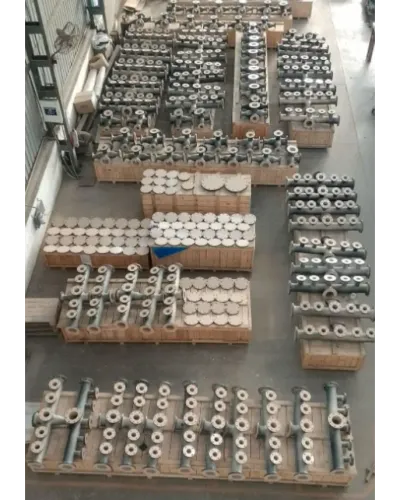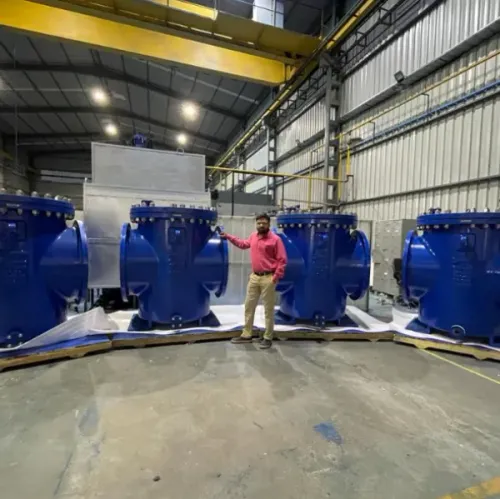
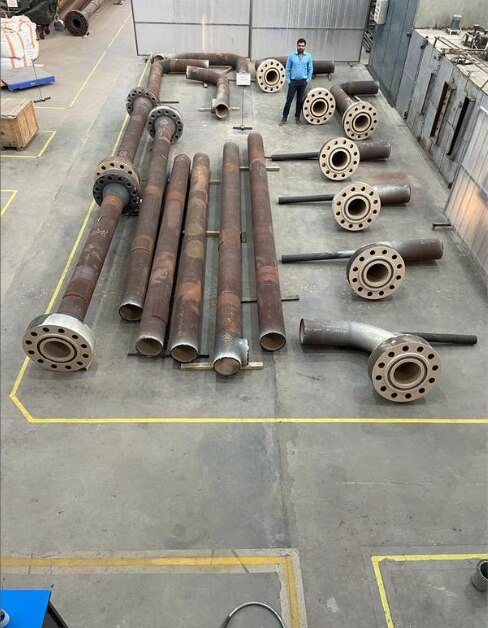
A seven-metre spool specification can describe a pipe that receives internal FBE, a cement-mortar-lined spool, or a coated component designed to connect to cement-lined pipe. By the end, you will know how to define the lining system, prepare the geometry and steel, set inspection requirements, and check whether a supplier can deliver a spool that survives coating, handling and installation.
Key takeaways
- Define whether the fluid contacts FBE, cement mortar, or an unlined interface.
- Match lining choice to fluid chemistry, temperature, pressure and flow conditions.
- Specify surface preparation, coating thickness, holiday testing and repair limits.
- Protect pipe ends and lining during handling, transport and field joint work.
What does “seven metre spool” mean when FBE and cement lining are both mentioned?
It does not automatically mean one spool receives both internal FBE and cement mortar. A request for seven metre spool fusion bond coating for cement lining in Ahmedabad must identify the intended lining, its sequence, and the surface that will contact the conveyed fluid.
1. One steel spool with two internal layers: confirm which material is applied first, whether the second layer bonds to or remains separated from the first, how each layer terminates, and how the completed lining is protected.
FBE and cement mortar are not interchangeable, and neither should be applied over the other without an approved system design.
2. An internally FBE-coated spool that connects to cement-lined pipe: define the joint location, lining transition, exposed end length, gasket arrangement, and field-joint treatment. The two linings must not be assumed to provide a continuous interface merely because the pipes are joined.
3. Separate coating and lining work: state whether the spool receives FBE only, cement mortar only, or separate work on different components. Fittings, branches, bends, reducers, valves and flange bores may require different equipment and procedures from straight pipe.
Before requesting a quotation, define whether seven metres means bare pipe barrel length, finished coated length, or the maximum transport length after lining. Give nominal bore, wall thickness, flange type, weld locations, bend radius, branch geometry, gasket faces, end preparation, allowable uncoated electrical-contact areas, and coating exclusion at each end.
Also state the conveyed medium, pressure, operating temperature, buried or above-ground service, abrasion exposure and required service life. Those details determine whether FBE, cement mortar, or neither system is suitable.
Which internal lining suits the conveyed medium and operating conditions?
Choose the lining by the fluid, solids content, chemistry and temperature—not by spool length. An internal FBE-coated spool in Ahmedabad is not interchangeable with a cement lining spool, and applying both to one internal surface requires an approved sequence, bond or separation condition, fluid-contact layer and termination detail.
| Option | Corrosion mechanism | Abrasion resistance | Chemical compatibility | Hydraulic smoothness | Repairability | Temperature limit |
|---|---|---|---|---|---|---|
| Internal FBE | Polymer barrier isolates steel from water, oxygen and chemicals | Smooth film resists moderate flow wear; sharp solids can gouge it | Depends on resin, immersion chemistry and concentration; verify against the fluid | Very smooth when correctly applied | Local defects can be prepared, patched and holiday-tested | Use only within the manufacturer’s qualified service-temperature range; thermal cycling can damage adhesion |
| Cement mortar | Alkaline mortar creates a physical barrier and passivates steel | Handles distributed slurry wear better, but chips under impact and at ends | Suits many water services; acids, low-pH fluids and aggressive chemicals can attack it | Rougher than FBE, increasing friction and turbulence | Damage is harder to detect and patch reliably, especially inside fittings | Sensitive to curing, rapid drying and thermal shock; confirm the project rating |
Neither system is automatically suitable for concentrated chemicals, severe erosive slurry, high-temperature cycling, or fluids that permeate or attack the selected lining. Obtain project-specific approval with immersion data, design temperature, velocity, solids size and concentration before specifying either system or an FBE-over-cement arrangement.
How is a seven-metre steel spool prepared and FBE-coated?
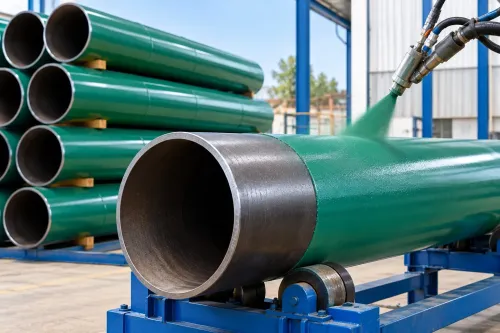
A seven-metre fusion bond coating spool succeeds or fails before powder reaches the steel. Confirm pipe identification, wall thickness, end exclusions and electrical-contact areas, then remove oil, grease, weld spatter, sharp edges and weld slag. Mask gasket faces, threads and other surfaces that must remain uncoated.
1. Abrasive-blast the steel to the specified grade, commonly ISO 8501-1 Sa 2½. Record soluble-salt readings, dust, abrasive cleanliness and the anchor profile; an attractive grey surface without the required profile will still produce weak adhesion.
2. Measure air temperature, steel temperature and relative humidity. Keep steel at least 3°C above calculated dew point during blasting and coating, or flash rust and trapped moisture can undermine the bond.
3. Preheat the spool uniformly to the powder manufacturer’s specified metal temperature. Check temperature around bends, branches, reducers, welds and fittings, not only at the seven-metre barrel’s centre.
4. Apply approved FBE powder electrostatically at the specified gun distance, voltage and deposition rate. Maintain the required dry-film thickness and prevent thin coverage at ends, inside corners and fitting transitions.
5. Cure by holding the steel within the powder supplier’s stated temperature-and-time window. Record actual metal temperature, not merely oven or induction-equipment settings; under-cure leaves a soft, poorly bonded film.
6. Measure thickness on the barrel and difficult geometry with calibrated equipment, then inspect visually. Run a holiday detector at the specified voltage over the complete coating, including ends and around fittings.
Repair holidays by feathering sound FBE, preparing exposed steel and applying a compatible approved repair material. Retest every repair for holidays and thickness where specified, and retain the readings, powder batch, environmental log and repair map.
How are cement lining, FBE interfaces and transport protection designed?
Set the sequence before fabrication: decide whether the cement lining is the fluid-contact layer, whether FBE is external only, or whether an FBE-coated spool will connect to cement-lined pipe. Do not place cement mortar over internal FBE without a qualified bond or separation design.
Define the seven metre coated spool as barrel length or finished length, plus coating exclusions at weld ends, gasket faces and electrical-contact areas.
- Complete welding, dimensional checks and external FBE first where the lining process could damage it; mask or protect every interface.
- Specify cement type for the chemistry: sulfate-resistant cement for sulfate exposure, or an approved potable-water cement where applicable. State the mortar’s cement, clean graded aggregate, water-cement ratio and admixtures; prohibit chloride-bearing additions.
- Set lining thickness from bore, pressure, abrasion and handling loads. State whether welded wire reinforcement or fibres are required; never treat reinforcement as automatic crack control.
- Apply the mortar continuously, finish the bore smooth, and form a sound bevel or seal at each end. Keep the lining off gasket faces and defined field-joint zones.
- Cure under controlled moisture and temperature for the specified period. Prevent rapid drying, freezing and impact; use shrinkage-control details such as restrained curing, approved admixtures or reinforcement.
Lift a cement lining spool with padded, engineered supports at marked points; never use chains against the lining or drag it. Fit end caps and internal impact protection, then inspect after transport with lighting, sounding, dimensional checks and a documented map of cracks, debonding, exposed reinforcement and damaged ends. A visually intact exterior proves little.
What should you put in the purchase specification and inspection file?
Put acceptance criteria in the purchase order, then require a signed inspection dossier before release. For a seven metre coated spool, identify every component separately rather than assuming straight-pipe equipment can process bends, reducers, branches, flanges or valves.
1. Record nominal diameter, wall thickness, outside diameter, spool length, bend radius, branch orientation, flange standard, face dimensions, weld locations and lifting points. Include drawings with tolerances and steel heat or pipe numbers.
2. Mark weld ends, flange faces, gasket seats, bonding pads and other uncoated electrical-contact areas on the drawing. State the masking length, permitted edge profile and continuity or holiday-test limits.
3. Specify the field-joint system: blast grade, profile, primer, FBE-compatible repair material, application temperature, overlap, thickness and post-installation holiday test. Shop coating does not protect the assembly weld.
4. For potable water, demand approval for the exact resin, curing agent and repair product, such as NSF/ANSI/CAN 61 where applicable. “Non-toxic” and an FBE pipeline standard are not substitutes.
5. File powder manufacturer, product code, batch number, shelf life, storage temperature, steel temperature, cure time and temperature, blast readings, dew-point records, dry-film measurements, holiday results, adhesion tests and repair maps.
6. For cement lining, retain cement, sand, water and admixture batch records, mix proportions, thickness readings, curing logs, end-finish inspection and shrinkage or crack reports.
7. Obtain repair instructions, nonconformance records, release inspection and transport-damage checks. For an internal FBE coated spool in Ahmedabad, ask Heatman Products Pvt Ltd for equipment lists, calibrated-gauge certificates, approved procedures, operator records and the inspection-and-test plan.
Related product
 | INTERNAL FBE COATED SPOOL 7 MTR INTERNAL FBE COATED SPOOL 7 MTR An internal FBE-coated spool is a pipeline component with its internal surfaces lined with fusion bonded epoxy (FBE) to protect against corrosion,... View product → |
Frequently asked questions
What does a seven-metre spool mean when FBE and cement lining are both mentioned?
It describes a steel spool approximately seven metres long, but it does not prove that one spool receives both linings. The specification must identify the lining, sequence and fluid-contacting surface.
Which internal lining suits the conveyed medium and operating conditions?
Choose FBE or cement mortar after checking the conveyed fluid, pH, chemical exposure, temperature, pressure, abrasion and flow conditions. Confirm compatibility with the lining manufacturer’s technical data.
How is a seven-metre steel spool prepared and FBE-coated?
The spool is inspected, abrasive-blast cleaned, checked for surface profile and contamination, heated within the powder manufacturer’s specified range, coated, cooled and tested for thickness, adhesion and holidays.
How are cement lining, FBE interfaces and transport protection designed?
Define termination details, end clearances, transitions, curing requirements and protection for coated surfaces. Use end caps and handling methods that prevent impact, moisture ingress and damage during transport.
What should you put in the purchase specification and inspection file?
Include spool dimensions, steel grade, lining system, service conditions, surface-preparation standard, coating thickness, test methods, acceptance limits, repair procedure, batch records, inspection reports and photographs.
Keywords